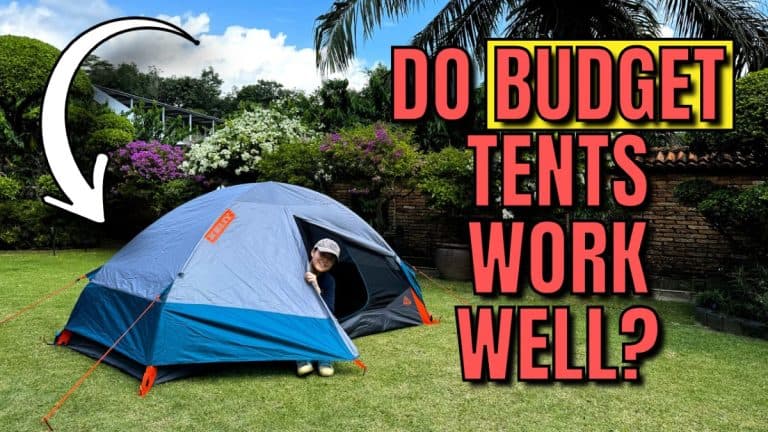
Tents under $200 · Review
Kelty Discovery Basecamp 6 Tent Review (Bought & Tested!)
I bought this tent with my own money and put it through 11 hands-on tests.
- Setup 10.5 min
- Peak 68in
- Base area 81.7 sq ft
- Weight 14.2 lbs

This page contains affiliate links, and that means that I may earn a commission if you buy something, at no extra cost to you. You can find my full disclosure policy here.
Test scorecard · scored against tents under $200
If you want the best 6-person tent you can get for under $200, the Kelty Discovery Basecamp 6 is the one I’d pick. It goes up fast, it stayed dry through an hour of heavy rain, and it’s the lightest of the three I tested.
- Very inexpensive
- Lifetime warranty
- Easy setup
- Lots of mesh
- Great in rain
- Awning can be longer
- Low peak height
- Not the most livable space
If you prefer watching to reading, check out my video here instead.
See the 11 tests
In the Box
Out of the box, this is what I got:
- Tent body
- Rainfly
- Poles × 3
- Stakes × 8, in a stake bag
- Carry bag and pole bag
- Instructions

Set Up & Pack Away
- Set-up time (1 person) 10.5 min
- Poles 32 for the tent body, 1 for the awning
- Pole clips 131 at the top, 12 around the tent
- Guylines 42 per side, pre-attached
Here’s the rough breakdown of the set-up:
- Secure each end of the 2 longer poles into Kelty’s "Quick Corner" sleeves.
- Clip the top pole clip on first, then the 12 others around the tent.
- Drape the rainfly over the tent, matching the colored webbing on the fly to the webbing on the tent body.
- Buckle the 4 easy-clip buckles at the corners.
- Secure the awning pole at the front, then guy out the pre-attached guylines.
Want the full step-by-step, with all my tips? Watch my Discovery Basecamp 6 set-up guide on YouTube.
Taking the tent down is just the opposite of the set-up, and it took me slightly less time. The carry bag has a shark-mouth opening, so everything was easy to fit back in.
- Pack away 9.5 min
Peak Height
- Peak height 68inonly in the middle: the rest of the tent slopes down


Base Area
- Floor 116.5 × 101in
- Base area 81.7 sq ft
- Single pads 6shoulder to shoulder
- Exped MegaMat Duo 74 x 43in (4in thick)
- Klymit Double V 74 x 46in (2.5in thick)
- Big Agnes sleeping bag ~70 x 25in
- Leftover space 1 more pad

It’s a tight squeeze. Sit up at the sides of the tent and the wall hangs just above you, with the mesh grazing your head.

- Queen beds 2 almost-queensa true queen is 80 x 60in
- Alps Vertex 80 x 56in
- Etekcity 80 x 59in

So you can’t actually fit 2 true queens in here. At 116.5in, the tent is a bit too short for that. With 4 people inside it’s roomier, but the sides still aren’t the most livable.
Windows
- Windows 1at the front: the other walls are pure mesh
- Window size 43 x 13in

- Held open by A toggle at the bottom
- Window zippers 21 going down, 1 following the curve of the window
I couldn’t find any branding on the window zippers, but they were very snag free. The one catch is that the awning pole sits under a lot of tension, which sometimes makes the window harder to zip shut.

Doors
- Doors 1at the front
- Door size 52 x 52inlongest length by longest width
- Ground to top of door 54inI still had to duck going in and out
- Held open by A toggle at the side

- Door zippers 2-wayunbranded, same as the window
- Rain flaps 2double the amount of snagging

The door snags quite often, and from the inside it droops inwards, which makes it hard to zip up one-handed. Guiding the zipper along with your other hand cuts the snagging a lot, inside and out.
Storage
- Pockets 8a mix of singles and doubles
- Single pocket 10 x 6in
- Double pocket Double the sizewith a separation down the middle
- Loops 5at the top, for hanging a lantern up at night

Ventilation
- Mesh 65-70% of the tent body3 of the 4 walls
- Vents 0
- Rainfly guy-out points Nonethe fly sits right up against the tent body

Take the fly off on a hot day and there’s a lot of mesh to breathe through, which is great for stargazing too. The front wall is full fabric though, so it isn’t quite a 360-degree view.

Rain Protection
Before the rain tests, here’s how this tent is built to keep water out:
- Floor fabric 18in up the wallseverything above it is mesh
- Floor seam taping All of itlengths, widths, corners, and the corner runs


- Front wall seams Taped
- Rainfly seams All taped
- Rainfly coverage Long on 3 sidesthe front is shorter, held up by the awning pole
Then I ran it through two rain tests:
- Light rain 3 hoursno leaks: the outside of the tent looked damp, but inside it was bone dry
- Heavy rain 1 hourno leaks
- Seams Drycorners included
- Fabric Dry
- Rainfly underside Dry

The awning is the weak spot. I measured it to see whether it at least overhangs the tent, and it doesn’t. There are still a few inches of exposed tent floor underneath it.

That short awning is also why opening the door in the rain drips water straight into the tent, and the door drooping inwards brings in more. A longer awning and a better door would fix both.
Quality
- Flooring 68D polyester1,200mm coating
- Rainfly 68D polyester1,200mm coating
- Canopy No-see-um mesh
- Poles Fiberglassabout 0.5in thick
- Zippers Unbranded
- Guylines Shockcordwith an easy-to-use tensioner
- Stakes Shepherd hook
- Warranty Lifetime
The tent meets flammability requirements, and it’s made in Bangladesh.
Portability
- Packed size 26 × 11 × 8in
- Total weight 14.2 lbs
- Carry bag Shark-mouth openingwith a small side pocket and a really good over-the-shoulder sling
Pros, Cons, Recommendations
Now, what are the pros and cons, and would I recommend the Kelty Discovery Basecamp 6?
Very inexpensive
Very inexpensive for a 6-person tent.
Lifetime warranty
A lifetime warranty is great at this price.
Easy setup
10.5 minutes is fast for a tent this big. No pole sleeves, and Kelty’s "Quick Corners" replace grommets, which shaves a minute or so off.
Easy pack away
The shark-mouth carry bag is well designed, so everything zipped away with no fuss.
Lots of mesh
3 walls are mesh, so there’s tons of ventilation for summer camping.
Great in rain
It didn’t leak at all, and so far I haven’t seen a tent of the same price and capacity perform better.
Awning can be longer
The awning is too short, so water rolls off the roof and into the tent. A bit longer and it would be perfect in the rain.
No vents
There are no vents for rainy day ventilation. No guy-out points at the bottom of the rainfly either, which would have pulled the fly off the tent body and done the same job.
Low peak height
At 68in, the peak height is low. It’s the shortest one on this list:
| 6P Tent | Peak Height (in) |
|---|---|
| Kelty Discovery 6 | 68 |
| NTK Cherokee 6 | 70 |
| REI Base Camp 6 | 73 |
| Coleman Sundome 6 | 74.5 |
| The North Face Wawona 6 | 77 |
| Caddis Rapid 6 | 77 |
| REI Wonderland 6 | 81 |
| Eureka Copper Canyon LX 6 | 84 |
Not the most livable space
A simple 2-pole dome, so there’s no extended peak height and no vertical walls. Not the best livable space, for sure.
Budget materials
The materials don’t seem to be the best either. The poles are fiberglass, and the floor is quite thin at 68D polyester. Still slightly better than the Coleman:
| Tent | Poles | Floor |
|---|---|---|
| Kelty Discovery 6 | Fiberglass (13mm) | 68D Polyester |
| Coleman Sundome 6 | Fiberglass (11mm) | Polyethylene |
Only 1 door
Just 1 door, at the front. The wall at the opposite end is mesh, with no door. The ALPS Meramac 6 I tested has 2 doors, though it’ll cost you a little more.
Overall recommendation
Overall, there’s an equal number of pros and cons, but if you’re looking for an inexpensive but good quality tent, this is probably one of the better ones out there. The Kelty Discovery Basecamp 6 was my pick of the three 6-person tents I tested under $200. One tip: if you can stretch about 10% more, Kelty’s Discovery Element 6 adds a proper vestibule at the front, so it’d score higher than this one.
Bonus: Must Read!
If you want more options when it comes to budget-friendly tents, I tested this one against the other tents I bought under $200 in my Best Tents Under $200 round-up.
Or, check out the Kelty Discovery Basecamp 6:
Every figure above is from my own testing. Measured by hand, bought with my own money.