7 tests × 8 camping tents
The 8 Best Camping Tents (Bought & Tested!)
I picked one camping tent from each of the 8 best tent brands. All 8 cost me a whopping $3,532 alone, and I spent about 2 months testing them all out.
This page contains affiliate links, and that means that I may earn a commission if you buy something, at no extra cost to you. You can find my full disclosure policy here.
The Podium
Quick Summary
Here’s everything I recommend.
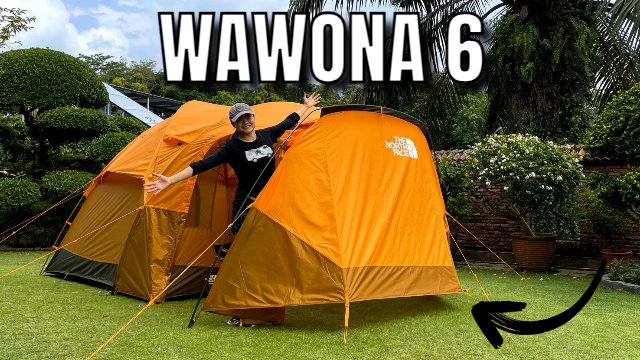
The North Face Wawona 6
My favorite family tent for summer, with fantastic rain and wind protection and the most spacious vestibule.
8.3/ 10 overall

Best Family Tent for the Off-Season
REI Base Camp 6
 8.3/10
- Full coverage rainfly
- 4 very user-friendly vents
- Most feature-rich family tent
- 14 pockets + 20 loops
Most Versatile Tent
Snow Peak Alpha Breeze
 8.0/10
- Can be used in summer AND off-season
- 100% zippable mesh panels
- Fantastic rain protection
- 4 doors
Most Spacious Tent
Big Agnes Bunk House 6
 8.4/10
- Biggest total area: 136.5 sq. ft.
- Extended peak height across length
- Excellent rain protection with full rainfly
- Great quality materials
Best Lightweight Tent
Mountain Hardwear Mineral King 3
 8.6/10
- Lightweight and packable: 7.6 lbs
- The most storage options
- Lots of mesh for summer
- Excellent quality
Best Instant Tent
Gazelle T4 Hub Tent
 7.3/10
- Fastest to setup and pack away
- Sets up in just 5.0 mins
- 100% walkability inside the tent
- Fantastic quality materials
Jump to: The Rest of the Best ↓ How I Tested ↓ Why You Can Trust Me ↓
The video

If you prefer watching to reading, check out my video here instead.

Camping Guidance
30K+
Table of contents
- 1. The North Face Wawona 6 (Best Family Tent for Summer)
- 2. REI Base Camp 6 (Best Family Tent for the Off-Season)
- 3. Snow Peak Alpha Breeze (Most Versatile Tent)
- 4. Big Agnes Bunk House 6 (Most Spacious Tent)
- 5. Mountain Hardwear Mineral King 3 (Best Lightweight Tent)
- 6. Gazelle T4 Hub Tent (Best Instant Tent)
- The Rest of the Best
- How I Tested All 8 Tents
- Why You Can Trust Me
Best Family Tent for Summer
The North Face Wawona 6
Test scorecard
The North Face Wawona 6
8.3out of 10
Ease of Use7
Spaciousness8.5
Features7.4
Ventilation8.6
Rain Protection9.8
Quality9.3
Portability7
Key info
- Peak height77.0 in
- Inner area75.7 sq. ft.
- Vestibule51.0 sq. ft.
- Set up (1P)20.0 mins
- Weight19.4 lbs
Pros
- Fantastic rain and wind protection
- High quality materials
- Most spacious vestibule
Cons
- Inner tent not as spacious
TL;DR
Even though there wasn’t the most space in the inner tent, I felt that the very generous vestibule still made the entire tent feel very roomy. That, plus the excellent quality and impressive rain protection made The North Face Wawona 6 one of my favorite camping tents.
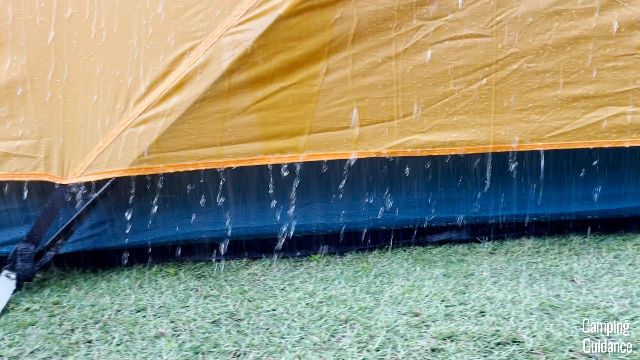
One of the biggest pros I’ve experienced with The North Face Wawona 6 is staying completely dry, even after many hours of pouring heavy rain, and even though the base of my tent was flooded with water up to a couple inches high.
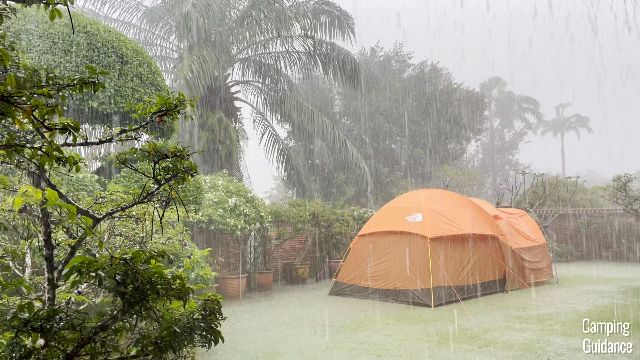
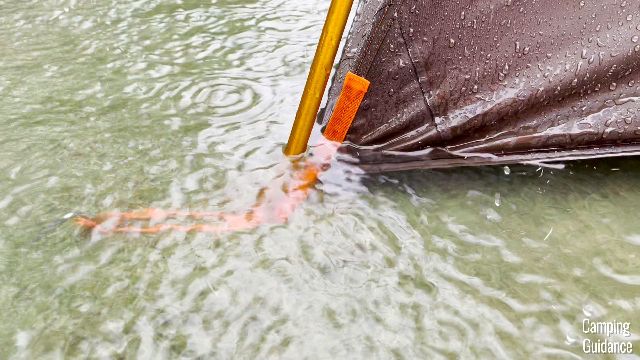
On top of just excellent rain protection, the Wawona also has the most guylines and some of the strongest poles of all the tents in this review. Here’s a quick summary of the 6 person tents in this review:
| Camping Tent | Guylines | Poles |
|---|---|---|
| The North Face Wawona 6 | 11 | DAC |
| Big Agnes Bunk House 6 | 8 | DAC |
| REI Base Camp 6 | 6 | Aluminum |
| NEMO Aurora 6 | 4 | Aluminum |
Typically, the more guylines, the better. And DAC poles are much stronger than other forms of aluminum.
Another fantastic pro of the Wawona is its incredibly spacious vestibule. The lowest height in the vestibule came in at 65 inches, the tallest height was 74 inches, and I could stand up everywhere inside. There was no other tent here that could do that.
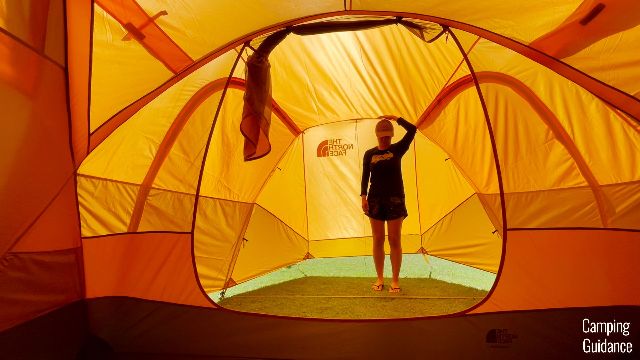
If a spacious vestibule for lounging is high on your list of priorities, there’s no better one than this. (Remember, I’ve tested more than 40 tents, so I can confirm this!)
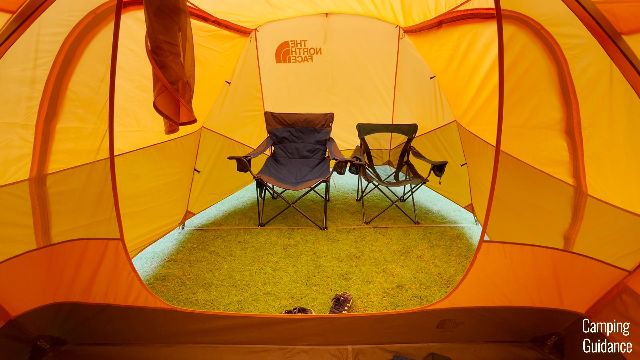
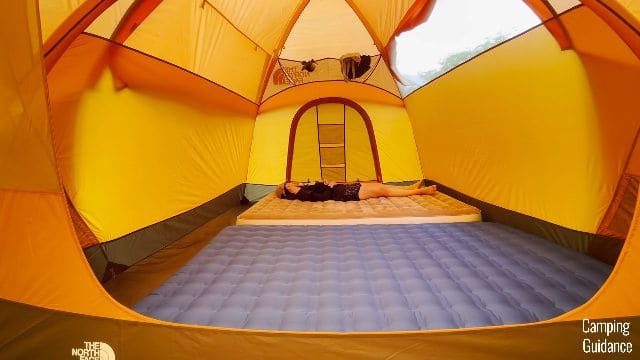
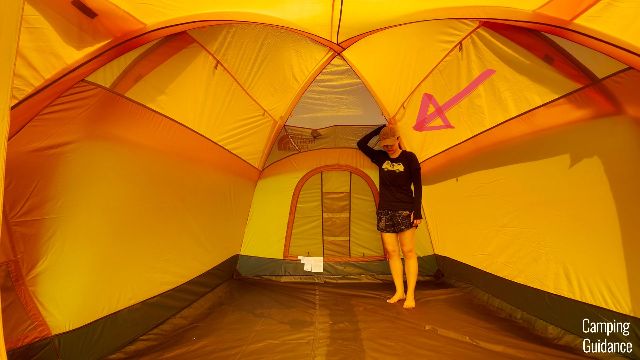
However, when it comes to the spaciousness of the inner tent, the Wawona has the smallest square footage of any 6-person tent, and also the second lowest score when it came to livable space.
Check out the Wawona 6:
Best Family Tent for the Off-Season
REI Base Camp 6

Test scorecard
REI Base Camp 6
8.3out of 10
Ease of Use7.5
Spaciousness8.5
Features9
Ventilation8.3
Rain Protection9.2
Quality8.4
Portability6.5
Key info
- Peak height73.0 in
- Inner area82.5 sq. ft.
- Vestibule52.4 sq. ft.
- Set up (1P)17.5 mins
- Weight20.6 lbs
Pros
- Full coverage rainfly
- Very user-friendly vents
- Most feature-rich family tent
Cons
- Poles are not DAC
TL;DR
Now, if you camp in colder weather, and you need a family-sized tent, this rules out the Wawona 6, and this REI Base Camp 6 is easily the most appropriate pick for you. Here’s why.
First, the Base Camp has a full coverage rainfly, which is not just excellent at rain protection, it also keeps heat inside the tent on colder days.
Second, the Base Camp also has 4 extremely user-friendly vents, all of which can be opened and shut from inside the tent. (Keep them closed if you need to keep the heat in.)
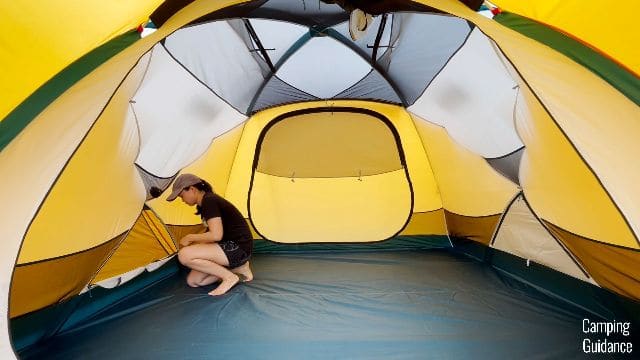
And third, there’s much less mesh on the Base Camp than a summer tent. This is crucial for making sure the heat doesn’t escape.
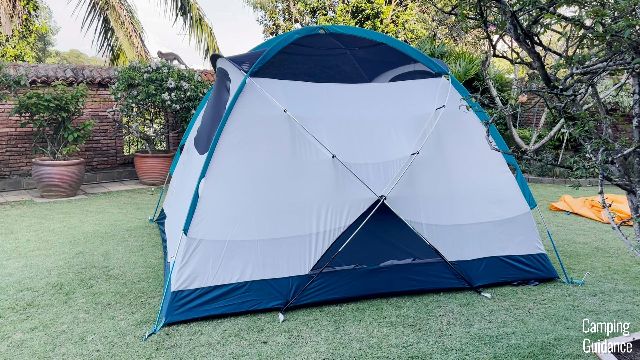

On top of these excellent cold-weather capabilities, this tent also has a ton of storage and other features. Here’s a quick list:
- 14 pockets
- 20 loops
- 2 huge doors
- 2 door pockets (included in the count above)
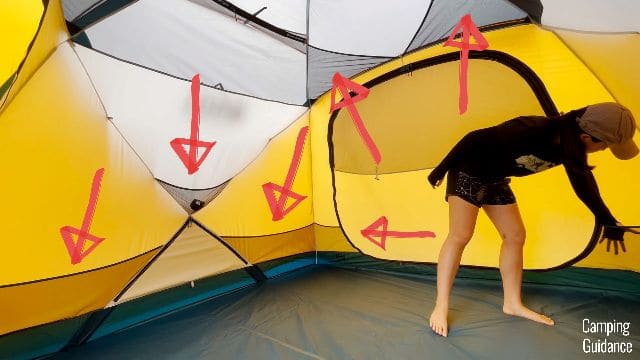
When it comes to 6-person family tents, you won’t get a more feature-rich tent than this.
The materials that the Base Camp 6 is made of are high-quality, except for the poles. I expect tent brands of this price-point to come with DAC poles, but REI uses just regular aluminum. (Thankfully, I haven’t had issues with mine.)
Check out the Base Camp 6:
Most Versatile Tent
Snow Peak Alpha Breeze

Test scorecard
Snow Peak Alpha Breeze
8.0out of 10
Ease of Use6
Spaciousness7
Features8.7
Ventilation9.4
Rain Protection10
Quality8.4
Portability6
Key info
- Peak height75.8 in
- Inner area74.7 sq. ft.
- Vestibule33.7 sq. ft.
- Set up (1P)19.0 mins
- Weight22.0 lbs
Pros
- Can be used in summer AND off-season
- Fantastic rain protection
- Excellent quality and design
- 4 doors
Cons
- A-frame reduces livable space at the back
- Not the easiest setup
TL;DR
What about a more versatile tent that can be used not just in summer, but also in the off-season? That’s easily the Snow Peak Alpha Breeze, with huge mesh panels that are 100% zippable. Let me show you.
When you zip all the mesh shut around the tent, the Alpha Breeze is able to trap a ton of heat inside for cold-weather use.

That, and the full-length rainfly, makes it great for the off-season. No other tents in this review allows you to zip up all the mesh like this.
And in the summer, you can open all the mesh panels, and get a tent that looks like this:

I also managed to put the Alpha Breeze through not 1, not 2, but more than 5 hours of heavy rain, and not a single drop of water got into the tent.

It also has excellent design and many, many features, including but not limited to:
- 4 windows
- The 4 windows can be turned into 4 doors
- An awning (all the poles, guylines and stakes were provided for this awning too!)
- 6 pockets
- 3 loops
- 2 vents (which can be opened and closed from the inside)
As for cons though, this tent has an A-frame shape, meaning the livable space in the back half takes a massive dip; you cannot stand up there at all.

The rainfly is also big and not color-coded, it took me quite a while to get it set up over the tent myself, so I found the setup more difficult than most. If you set this up with 2 people though, it’s much easier.
Check out the Alpha Breeze:
Most Spacious Tent
Big Agnes Bunk House 6

Test scorecard
Big Agnes Bunk House 6
8.4out of 10
Ease of Use7.5
Spaciousness9.5
Features8.2
Ventilation7.8
Rain Protection9.2
Quality8.9
Portability7.5
Key info
- Peak height77.3 in
- Inner area80.5 sq. ft.
- Vestibule56.0 sq. ft.
- Set up (1P)18.0 mins
- Weight18.6 lbs
Pros
- Extended peak height across length
- Spacious vestibule
- Excellent rain protection with full rainfly
- Great quality materials
Cons
- Expensive
- Flooring can be thicker
TL;DR
If you need a spacious inner tent along with a roomy vestibule, and you expect heavy rains and winds, the Big Agnes Bunk House 6 is your best pick.
The Bunk House 6 has a ridge pole at the top that runs the entire length of the tent, giving it a tunnel shape, and allowing me to stand upright throughout the entire length.

The vestibule is also spacious with a peak height of about 67.5 inches.

But take note that this vestibule isn’t nearly as spacious as the Wawona’s though. The height of the front door was a mere 58 inches. (I kept bumping my head on it at first.)
Now, most spacious cabin and tunnel tents tend not to have full rainflies, and hence not great rain protection, but the Bunk House is the exception, and I was able to put it through 2 hours of heavy rain without a single leak.

On top of that, for wind protection, the Bunk House comes with 6 main tent guylines, 4 of which are forked for added stability.
All the Bunk House’s poles are made of DAC too, which is also great for wind.

It’s expensive though.
And surprisingly, I found the flooring on the Bunk House to be half as thick as other tents this size. So, please get a footprint to protect the base if you’re buying this.
Check out the Bunk House 6:
Best Lightweight Tent
Mountain Hardwear Mineral King 3

Test scorecard
Mountain Hardwear Mineral King 3
8.6out of 10
Ease of Use7
Spaciousness7.5
Features9.3
Ventilation9.4
Rain Protection8.4
Quality8.9
Portability10
Key info
- Peak height47.3 in
- Inner area41.1 sq. ft.
- Vestibule21.0 sq. ft.
- Set up (1P)8.75 mins
- Weight7.6 lbs
Pros
- Lightweight and packable
- The most feature-rich tent
- Lots of mesh for summer
- Excellent quality
Cons
- Pricier than most
TL;DR
If you’re looking for a lightweight, feature-rich, high-quality summer tent that could double as a backpacking tent for shorter trips (emphasis on shorter, because these tents aren’t the ultralight type), the best one I’ve tested is the Mountain Hardwear Mineral King 2/3.
I bought the Mineral King 3, and found that it had more than enough space to fit 2 regular pads plus 1 wide pad:

And it packed down to about the same size as a 2-person Coleman Sundome tent, despite being a 3-person size:

This Mineral King 3 also has a ton of storage options and features (it scored the highest of all the tents here):
- 7 huge pockets
- 9 loops (4 closed loops, 5 opened loops)
- 1 clothesline (divided into 10 segments)
- 2 extra wide-mouthed doors
- 2 additional door-stowing pockets


I’ve never seen so much storage and such excellent features in another tent of this size.
Yet another feature the Mineral King has is that it’s made of more mesh than fabric, for a ton of summer ventilation.

The materials and design of this tent is also superb:
- Floor: 68D Polyester Ripstop
- Footprint: 75D Polyester Taffeta
- Canopy: 75D Polyester Ripstop
- Rainfly: 68D Polyester Ripstop
- Poles: DAC Pressfit
- Zippers: YKK
- Mesh: 40D Polyester
However, it’s quite expensive for a 3-person tent.
Check out the Mineral King 3:
Best Instant Tent
Gazelle T4 Hub Tent
Test scorecard
Gazelle T4 Hub Tent
7.3out of 10
Ease of Use10
Spaciousness8
Features4.8
Ventilation7.1
Rain Protection7.2
Quality8.6
Portability4
Key info
- Peak height77.5 in
- Inner area61.0 sq. ft.
- VestibuleNone (T4 Hub)
- Set up (1P)5.0 mins
- Weight34.0 lbs
Pros
- Fastest to setup and pack away
- Fantastic quality materials
- 100% walkability inside the tent
Cons
- Smallest rainfly
- Extremely bulky
TL;DR
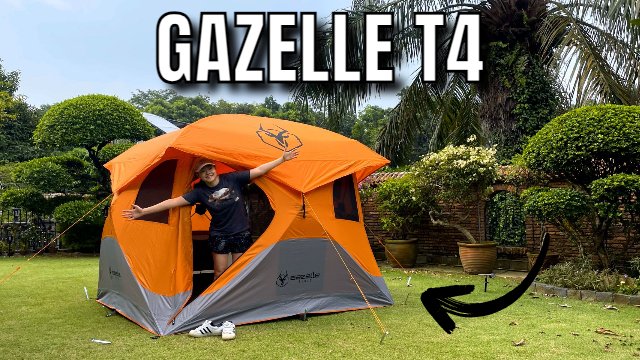
If you’re looking for an instant tent, the Gazelle T4 Hub Tent is easily the best one I’ve tested (and I’ve tested 6 others from different brands).
Of course, the set up and pack away was the quickest of all the tents in this review, by far:
- Setup: 5.0 mins
- Pack away: 6.0 mins
On top of that, the materials are the thickest of all the tents here:
- Floor: 300D Oxford Polyester
- Body: 210D Oxford Polyester
- Rainfly: 210D Polyester
- Zippers: YKK
Yet another pro of this tent is its massive interior (it’s more spacious than the Bunk House!).
Its peak height is 77.5 inches, the lowest height in the tent was still a whopping 67 inches, so still taller than me, and I could walk around the entire tent for 100% walkability.

However, as with most cabin and instant tents, the rainfly isn’t very big, so the seams not covered by the fly will start to leak a few hours in.

Also, the packed length is extremely long, so it won’t be able to fit into smaller cars.
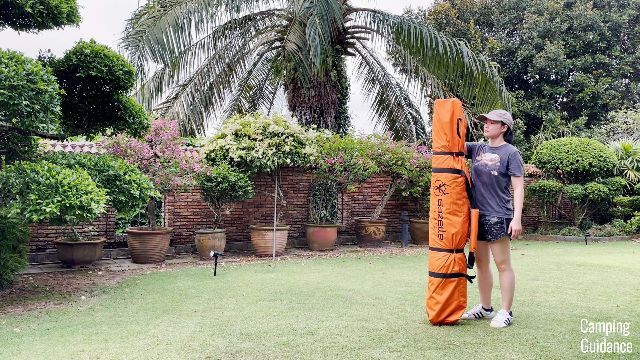
The Gazelle T4 I bought doesn’t come with a vestibule, but if you want one, get the Gazelle T4 Tandem instead:

Otherwise, check out the T4 Hub Tent:
Everything else I tested
The Rest of the Best
Above are my 6 picks. Here’s everything else I bought and tested for this review, and why each one didn’t make the podium:
- NEMO Aurora Highrise 6 (8.1): Has some nice pros, like the easiest 6-person set up and pack away, and a cool floor pattern that makes the tent feel more homely. But apart from that it’s not the best in anything, and it lacks some features compared to the other 6-person tents here. I’d go for the Wawona 6 or the Base Camp 6 instead.
- Marmot Tungsten 4 (7.8): The best thing about the Tungsten 4 is its packability. The rest of its features are simply just average, and its waterproofing and quality control are slightly below average. If you need a lightweight, packable tent, get the Mineral King 3 instead.
The 7 testsHow I Tested All 8 Tents
Typically, I try to look for as much quantitative data as possible, and that’s everything you’ll find in this section.
- All timings are 1-person: I set every tent up and packed it away myself, but after lots and lots of practice with each tent
- Pro-Tip: For how I analyzed the data, please watch the YouTube video at the top of this page for more context
Ease of Use
For ease of use, I timed myself setting each tent up and packing everything away. This excludes setting up the footprint for some of the tents that provided that, but it includes setting up everything else, so even all the possible stakes and guylines:
Related: Best Pop Up Camping Tents
| Camping Tent | Set Up (mins) | Set Up /Pax | Pack Away (mins) | Pack Away /Pax |
|---|---|---|---|---|
| Gazelle T4 Hub Tent winner | 5.0 | 1.3 | 6.0 | 1.5 |
| Mountain Hardwear MK 3 | 8.75 | 2.9 | 8.3 | 2.8 |
| Marmot Tungsten 4 | 11.8 | 3.0 | 10.8 | 2.7 |
| NEMO Aurora 6 | 13.0 | 2.2 | 11.0 | 1.8 |
| REI Base Camp 6 | 17.5 | 2.9 | 15.0 | 2.5 |
| Big Agnes Bunk House 6 | 18.0 | 3.0 | 13.0 | 2.2 |
| Snow Peak Alpha Breeze | 19.0 | 3.8 | 13.5 | 2.7 |
| The North Face Wawona 6 | 20.0 | 3.3 | 14.0 | 2.3 |
All 1-person timings (I set up and packed every tent myself), arranged fastest to slowest in set up. /Pax = the timing divided by the number of people the tent is rated for, since we have 3 to 6-person tents here.
- The Gazelle sets up 2-3x more quickly than everything else: It’s an instant tent with pre-attached poles, so all you need to do is pull on the wall hubs and the tent pops open on its own. Its pack away is about 50% faster per pax too
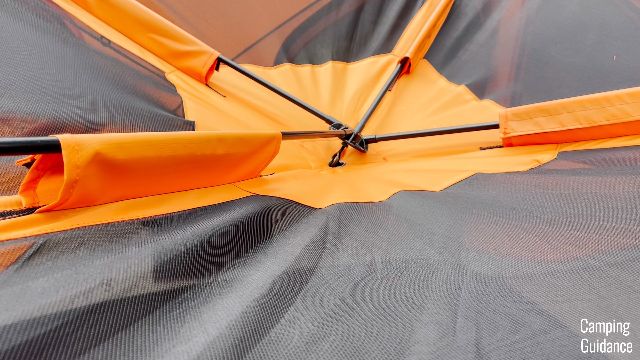
- Most non-instant tents land at about 3 mins per pax: The one anomaly is the NEMO Aurora 6 (2.2). It has the smallest fly of the non-instant tents, and the vestibules aren’t super big as well, so it was quite quick to set up. Generally, smaller and less features means a faster setup
- Bigger fly + more features = longer setup: The Snow Peak and the Wawona took me the longest. These had bigger rainflies that were a bit more difficult to set up, but overall not a big issue for me
Spaciousness
For spaciousness, I looked at the peak height of each tent, the overall livable space (tent shape, heights at various places, and how much I could walk around), and the base area, both inside the tent and out in the vestibule:
Related: Best Cabin Tents · Best 10-Person Tents
| Camping Tent | Peak Height (in) | Shape | Walkability |
|---|---|---|---|
| NEMO Aurora 6 | 77.8 | Dome | 70% |
| Gazelle T4 Hub Tent | 77.5 | Cabin | 100% |
| Big Agnes Bunk House 6 | 77.3 | Tunnel | 80% |
| The North Face Wawona 6 | 77.0 | Dome | 60% |
| Snow Peak Alpha Breeze | 75.8 | A-Frame | 50% |
| REI Base Camp 6 | 73.0 | Dome | 70% |
| Marmot Tungsten 4 | 52.3 | Dome | N.A.* |
| Mountain Hardwear MK 3 | 47.3 | Dome | N.A.* |
*No standing room in the smaller 3 to 4-person tents. Both have a ridge pole though, so if they were taller, I’d peg them at about 70% walkability. Every tent here sets up 1-2 ridge poles for extra livable space.
- Cabin and tunnel shapes are the most livable: The Gazelle’s 4 vertical walls gave it standing height across practically the entire tent, and the Bunk House’s ridge pole runs the entire length of the tent, so I could stand upright throughout
- If you want at least a bit of standing room, avoid the last two rows: The Snow Peak and Gazelle are the exceptions here, each with standing room despite being a 4-to-5-person tent, and the 6-person tents all have at least 6 feet of standing room under the peak
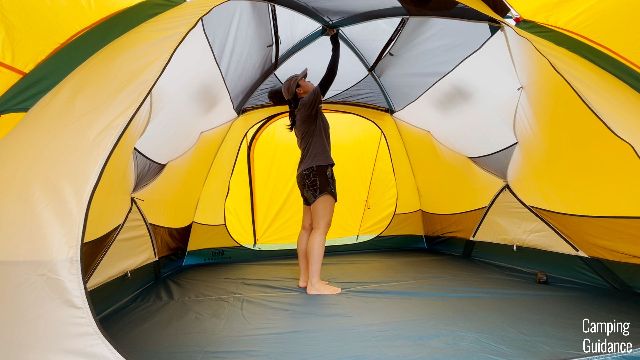
- Ridge pole direction matters: The NEMO’s and Base Camp’s ridge poles run width to width (70% walkability), while the Bunk House’s runs the full length (80%). The Wawona and Snow Peak have just 1 ridge pole at the front, and the Snow Peak’s A-frame back drops all the way to 50%
| Camping Tent | Inner Tent (sq. ft.) | Vestibule (sq. ft.) | Total (sq. ft.) | Area /Pax |
|---|---|---|---|---|
| Big Agnes Bunk House 6 winner | 80.5 | 56.0 | 136.5 | 22.8 |
| REI Base Camp 6 | 82.5 | 52.4 | 134.9 | 22.5 |
| NEMO Aurora 6 | 79.5 | 48.8 | 128.3 | 21.4 |
| The North Face Wawona 6 | 75.7 | 51.0 | 126.7 | 21.1 |
| Snow Peak Alpha Breeze | 74.7 | 33.7 | 108.4 | 21.7 |
| Marmot Tungsten 4 | 51.2 | 34.0 | 85.2 | 21.3 |
| Mountain Hardwear MK 3 | 41.1 | 21.0 | 62.1 | 20.7 |
| Gazelle T4 Hub Tent | 61.0 | 0 | 61.0 | 15.3 |
Typically you get anywhere from 20 to 23 sq. ft. per person. The Gazelle T4 Hub has no vestibule. If you want one, the T4 Tandem version adds a 49.0 sq. ft. vestibule for about 110 sq. ft. total, or 27.5 sq. ft. per person, the most of all the tents here.
- Only 2 vestibules have standing room: The Bunk House’s peaks at about 67.5 in (58 in at the front door), and the Wawona’s runs 65 to 74 in, so I could stand up everywhere inside it. You won’t be able to stand up or walk around in any of the others
And just in case you need some pad and mattress sizing info:
| Camping Tent | Pads | Queens |
|---|---|---|
| NEMO Aurora 6 | 6 | <2 (2 in short)* |
| Big Agnes Bunk House 6 | 6 | <2 (4 in short)* |
| The North Face Wawona 6 | 6 | <2 (4 in short)* |
| REI Base Camp 6 | 6 | 1 (+ single) |
| Snow Peak Alpha Breeze | 5 | 1 (+ single) |
| Gazelle T4 Hub Tent | 4 | 1 (+ pad) |
| Marmot Tungsten 4 | 4 | 1 (+ pad) |
| Mountain Hardwear MK 3 | 3 | 1 |
*Can technically fit 2 queens, but it will bulge out the tent a bit.
Features
For features, the most important part of any tent is usually the doors. I counted them, measured the size of each one, and checked whether the zipping is snag-free and how easily the door fabric stows away:
| Camping Tent | Doors | Size* | Zipping | Stowing |
|---|---|---|---|---|
| Snow Peak Alpha Breeze | 4 | 80%, 60%, 30%, 30% | Snag-free | Toggles |
| Mountain Hardwear MK 3 | 2 | 80%, 80% | Snag-free | Pockets |
| REI Base Camp 6 | 2 | 80%, 80% | Snag-free | Pockets |
| NEMO Aurora 6 | 2 | 80%, 40% | Snag-free | Pockets |
| The North Face Wawona 6 | 2 | 90%, 30% | Snag-free | Toggles |
| Big Agnes Bunk House 6 | 2 | 60%, 60% | Snag-free | Door Keeper |
| Marmot Tungsten 4 | 2 | 60%, 60% | Snag-free | Toggles |
| Gazelle T4 Hub Tent | 2 | 20%, 20% | Snag-free | Tie-downs |
*Door size as a percentage of the wall it’s on, since we have tents of all different sizes here (bigger tents = bigger doors). The first number is the front door, the second is the back door.
- Pockets are the most user-friendly stowing: About 3 seconds to stow a door away (Big Agnes’s Door Keeper is like a pocket, 3 seconds too). Toggles take 10 to 15 seconds, and Gazelle’s tie-downs take the longest at more than 20 seconds

- The Wawona’s front door (90%) is the only one taller than me: I did not have to duck when getting in and out of the tent, which was really, really nice. Its back door is really, really small though (30%)

- The Gazelle’s doors are really tiny (20%): I tripped over them a few times before, so it takes some getting used to
Now that we’re done with the doors, we’ll look at the rest of the features, so the number of windows each tent has, plus storage too, like pockets, loops, and other options such as clotheslines:
| Camping Tent | Windows | Pockets | Loops | Lines | Total /Pax |
|---|---|---|---|---|---|
| Mountain Hardwear MK 3 winner | 0 | 7 | 9 | (6) | 22/3 = 7.3 |
| REI Base Camp 6 | 2 | 14 | 20 | 0 | 36/6 = 6.0 |
| Big Agnes Bunk House 6 | 2 | 16 | 17 | 0 | 35/6 = 5.8 |
| Gazelle T4 Hub Tent | 8 | 7 | 0 | 0 | 15/4 = 3.8 |
| The North Face Wawona 6 | 1 | 9 | 8 | 0 | 18/6 = 3.0 |
| NEMO Aurora 6 | 2 | 7 | 9 | 0 | 18/6 = 3.0 |
| Marmot Tungsten 4 | 0 | 6 | 5 | 0 | 11/4 = 2.8 |
| Snow Peak Alpha Breeze | 4 | 6 | 3 | 0 | 13/5 = 2.6 |
The Mineral King’s clothesline is actually 1 long line across the entire tent, but it’s so long it could easily be split into 6 parts.
- Smaller 3 to 4-person lightweight tents tend not to have windows: Bigger tents will, and the Gazelle has a whopping 8 of them
- For a 3-person tent, the Mineral King has an insane number of storage options: 22 in total, or 7.3 per person. I could hang up so much stuff in this tent
Ventilation
For ventilation, I estimated the overall amount of mesh on each tent (your hot-day ventilation without the fly), and counted the vents (your rainy-day ventilation with the fly on):
| Camping Tent | Mesh* | Vents |
|---|---|---|
| Mountain Hardwear MK 3 winner | 60% | 2 |
| Snow Peak Alpha Breeze winner | 0-30% | 2 |
| Marmot Tungsten 4 | 45% | 2 |
| The North Face Wawona 6 | 30% | 4 |
| NEMO Aurora 6 | 25-30% | 2 |
| REI Base Camp 6 | 10-20% | 4 |
| Big Agnes Bunk House 6 | 25-30% | 0 |
| Gazelle T4 Hub Tent | 10-20% | 0 |
*A variable amount of mesh = zippable mesh. The percentages are my estimates from eye-balling each tent, but they’re enough to give you a good idea of how much mesh you get.
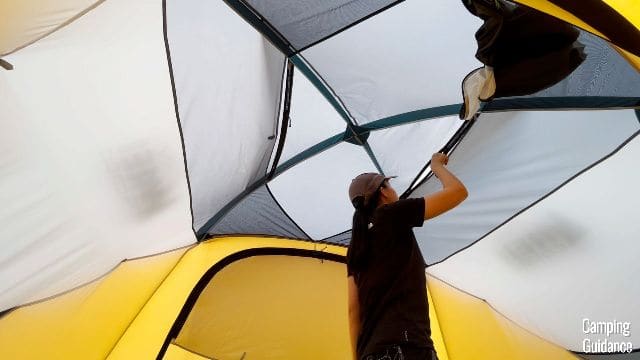
- The Snow Peak’s zippable mesh is the best by far: Fully closed for off-season use, fully open for summer. No other tent here lets you zip up all the mesh like this
- Pure summer tents: The Wawona’s big doors and top mesh panel aren’t zippable, and the NEMO and Big Agnes let you zip/cinch only the windows
- More suitable for the off-season: The Base Camp and Gazelle have much less mesh than the average tent here (10-20% each)
- The vents are all rain-friendly: The Wawona’s 4 vents can be left open in heavy rain; 2 of the Base Camp’s 4 have to be shut in heavy rain, but I could do it from inside the tent, no problem
Rain Protection
For rain protection, I first looked at the waterproofing features of each tent. Then, I actually tested every single one, with at least 1 hour of heavy rain each, and some going through much, much more:
Related: Best Waterproof Tents
| Camping Tent | Tub Floor | Seam Taping | Full Rainfly |
|---|---|---|---|
| Snow Peak Alpha Breeze | Yes | Yes | Yes |
| Mountain Hardwear MK 3 | Yes | Yes | Yes |
| Big Agnes Bunk House 6 | No | Yes | Yes |
| REI Base Camp 6 | No | Yes | Yes |
| Marmot Tungsten 4 | No | Yes | Yes |
| Gazelle T4 Hub Tent | Yes | Yes | No |
| The North Face Wawona 6 | No | Yes | No |
| NEMO Aurora 6 | No | Yes | No |
As long as the seam taping is good (especially on the flooring), you don’t technically need a tub floor. The most important feature here is the rainfly: for many days of non-stop heavy rain, I highly recommend a full rainfly, which keeps the inner tent body dry at all times, even if it’s completely soaked through on the outside.
And this is how good each tent actually was in the rain:
| Camping Tent | 1-Hour Test | 5-Hour Test |
|---|---|---|
| Snow Peak Alpha Breeze winner | No leaks | No leaks |
| The North Face Wawona 6 | No leaks | No leaks |
| Big Agnes Bunk House 6 | No leaks | Not tested (Estimated: No leaks) |
| REI Base Camp 6 | No leaks | Not tested (Estimated: No leaks) |
| NEMO Aurora 6 | No leaks | Not tested (Estimated ~4-5 hours) |
| Mountain Hardwear MK 3 | No leaks | ~4-5 hours (Rainfly) |
| Marmot Tungsten 4 | No leaks | ~2-3 hours (Rainfly) |
| Gazelle T4 Hub Tent | No leaks | ~2-3 hours (Seams) |
The Bunk House, Base Camp and NEMO were each tested up to 2 hours, so beyond that is my estimate.
- The Snow Peak and the Wawona breezed through 5 hours with no leaks at all: But the Snow Peak has a full rainfly and the Wawona does not. When I put the Wawona through 2-3 days of heavy rain, the water eventually started to soak in through the tent walls, so anything touching them got wet
- The NEMO’s rainfly was starting to look damp at close to 2 hours: So I’d estimate this tent to go through maybe 4-5 hours of heavy rain
- A damp fly doesn’t mean a wet tent: The Mineral King and the Marmot have full rainflies, so even when each fly got damp (at the 5-hour and 2-3 hour marks), the inside of both tents was perfectly fine. It’s also really important to guy out the widths of the tent, which you can on both, to keep the wet fly away from the body
- The Gazelle has a really short fly: I noticed wet seams after a few hours. That’s why I’d typically recommend a tent with a full fly if you’re expecting super heavy rain over many days
- I also put 2 tents through a flooding test: The Wawona was perfectly dry after many hours of flooding, but the Marmot’s seams let in a huge puddle of water after just a couple of hours

Quality
For quality, I looked at the materials of every part of each tent, any durability issues I ran into, and each brand’s warranty. Here’s everything, arranged from my highest-rated quality down:
Related: Best Coleman Tents · Best REI Tents
| Camping Tent | Flooring | Tent Body | Rainfly | Poles | Zippers | Mesh | Guylines |
|---|---|---|---|---|---|---|---|
| The North Face Wawona 6 winner | 150D Polyester | 75D Polyester | 75D Polyester | DAC | SBS (All) | Micro | 11 |
| Big Agnes Bunk House 6 | 75D Polyester Taffeta | 75D Polyester | 75D Polyester Taffeta | DAC | YKK (All) | 40D Nylon (Micro) | 8 (4 forked) |
| Mountain Hardwear MK 3 | 68D Polyester Ripstop (+75D) | 75D Polyester Ripstop | 68D Polyester Ripstop | DAC | YKK (All) | 40D Polyester (Micro) | 4 |
| Gazelle T4 Hub Tent | 300D Oxford Polyester | 210D Oxford Polyester | 210D Polyester | Fiberglass | YKK (Doors) | Mosquito | 4 |
| REI Base Camp 6 | 150D Polyester | 75D Polyester Taffeta | 75D Polyester Taffeta | Aluminum | YKK (Doors) | 40D Nylon (Micro) | 6 |
| Snow Peak Alpha Breeze | 40D Nylon Ripstop | 75D Polyester Ripstop | 75D Polyester Ripstop | 6061 | YKK (All) | Mosquito | 7 |
| NEMO Aurora 6 | 150D Polyester | 68D Polyester | 68D Polyester | Aluminum | No brand | No-see-um | 4 |
| Marmot Tungsten 4 | 68D Polyester Taffeta (+68D) | 68D Polyester Ripstop | 68D Polyester Ripstop | Aluminum | No brand | Micro | 4 |
(+75D) and (+68D) = a provided footprint, worn under the flooring. Warranty is lifetime from every brand except Gazelle and REI (1 year each).
- DAC poles are the highest quality: I’ve never had any issues with any of them. Snow Peak’s 6061 aircraft-grade aluminum poles are stronger than regular aluminum, and Gazelle uses fiberglass because its instant pop-up mechanism needs a flexible material
- The Marmot had my only durability issues: Its regular-aluminum poles are so thin (9mm, vs the Mineral King’s 10mm DAC) that one cracked after a few uses, and I also managed to rip a small hole in its 68D flooring. Both are easily repairable, but that’s why you definitely need the provided footprint

- Typical camping tents have ~150D polyester flooring: I’m not sure why the Big Agnes came in at only 75D (even though it’s slightly stronger poly-taffeta). Its flooring is about half as thick as other tents this size, so please get a footprint to protect the base
- Expecting wind? The Big Agnes and the Wawona are the best here, with the most tie-downs (8 and 11 guylines), and 4 of the Bunk House’s are forked for added stability
Portability
Finally, I weighed each tent with all the components that were provided, and measured the packed size of everything in its carry bag:
Related: Best Budget Backpacking Tents
| Camping Tent | Footprint* | Weight (lbs) | Weight /Pax | Packed Size (in) | Volume (in³) |
|---|---|---|---|---|---|
| Mountain Hardwear MK 3 winner | Yes | 7.6 | 2.5 | 23.0 x 9.5 x 6.5 | 1,420 |
| Marmot Tungsten 4 | Yes | 9.4 | 2.4 | 24.5 x 11.25 x 7.5 | 2,067 |
| NEMO Aurora 6 | No | 17.6 | 2.9 | 27.3 x 13.5 x 8.5 | 3,127 |
| Big Agnes Bunk House 6 | No | 18.6 | 3.1 | 27.0 x 16.3 x 9.0 | 3,949 |
| The North Face Wawona 6 | No | 19.4 | 3.2 | 26.0 x 16.0 x 10.0 | 4,160 |
| REI Base Camp 6 | No | 20.6 | 3.4 | 28.0 x 13.0 x 9.5 | 3,458 |
| Snow Peak Alpha Breeze | No | 22.0 | 4.4 | 28.0 x 13.0 x 11.0 | 4,004 |
| Gazelle T4 Hub Tent | No | 34.0 | 8.5 | 68.0 x 13.0 x 10.0 | 8,840 |
*Footprint weight (~12 oz for the 3P, ~15 oz for the 4P) is included in the total weight.
- Only 2 tents here weigh less than 10 lbs: The Mineral King and the Marmot, both lightweight and packable enough to double as backpacking tents for shorter trips

- The rest come in at about the 20-pound range: And the Gazelle is the only tent that weighs more than 30 pounds
- The Gazelle is ridiculously long when packed (68 in): So if you have a smaller car, double-check it against the dimensions here before buying
All Test Scores
Related: Best Tents Under $100
Related: Best Tents Under $200
The scoreboard
Based on the 7 tests above, here are the overall scores of all the camping tents in this review.
- Mountain Hardwear Mineral King 3Best Lightweight Tent8.6
- Big Agnes Bunk House 6Most Spacious Tent8.4
- The North Face Wawona 6Best Family Tent for Summer8.3
- REI Base Camp 6Best Family Tent for the Off-Season8.3
- NEMO Aurora Highrise 68.1
- Snow Peak Alpha BreezeMost Versatile Tent8.0
- Marmot Tungsten 47.8
- Gazelle T4 Hub TentBest Instant Tent7.3
Highlighted rows = my picks reviewed above. The NEMO Aurora Highrise 6 and the Marmot Tungsten 4 score well, but neither is the best at any one thing, and every one of my picks wins its own category.
See every sub-score and test weightage

The methodWhy You Can Trust Me
$3,532
I bought all the tents in this review with my own savings, and the total amount I spent was $3,532. This allows me to test them as objectively as possible, without needing to censor anything I say about them.
2 months
I spent about 2 months testing these 8 tents, and at least a week with each one (sometimes more, especially if I really like the tent), gathering all the data that you’ve seen above.
7 tests
Every tent went through the same 7 scored tests: ease of use, spaciousness, features, ventilation, rain protection, quality and portability. Every score above comes from those tests.
40+ tents
Over the past 6 years, I’ve tested more than 40 camping tents. You can find videos on all of them over on my YouTube channel, along with 30,000+ subscribers.
Every figure above is from my own testing. Measured by hand, bought with my own money.


