Lantern flashlights · Review
Nitecore LR70 Review (Bought & Tested!)
Nitecore sent me this lantern flashlight, I submerged it and it died, so I bought a new one to complete the testing. 15 hands-on tests altogether.
- Power 10,000 mAh
- Lantern 1,090 lumens
- Flashlight 5,099 lumens
- Run-time 780 hrs

This page contains affiliate links, and that means that I may earn a commission if you buy something, at no extra cost to you. You can find my full disclosure policy here.
Test scorecard · scored against lantern flashlights
I tested 7 lantern flashlights, and the Nitecore LR70 is the best-scoring one by a clear margin. You get 12 light modes, the widest brightness range of all of them and a 10,000 mAh battery, though it’s also the most expensive one I’ve tested.
- 12 light modes, including red
- Huge brightness range
- 10,000 mAh battery
- Feature-rich
- The most expensive one I tested
If you prefer watching to reading, check out my video here instead.
See the 15 tests
In the Box
- The Nitecore LR70
- A USB-C to USB-C cable
- A user guide
- Warranty information

Light Modes
- Lantern button: Frontthe one with the lantern icon
- Flashlight button: Sidethe one with the flashlight icon
- Both on at once: No

The white lantern is the mode you’ll use most:
- On and off: Long press
- Cycle Low → Mid → High: Short press

You can access the red modes using the same button:
- Enter red from off: Double pressit starts on Low
- Cycle Low → High → Beacon → SOS: Short press

And the flashlight runs off its own button:
- On and off: Long pressit starts on Low
- Cycle Low → Mid → High → Higher: Short press
- Jump to Turbo from any mode: Double press

That’s 12 modes in total. The flashlight remembers the brightness you last used, but the lantern doesn’t, so it always comes back on Low.
Run Times
I charged it fully, left each mode running, and timed how long it lasted.
| Mode | Brightness | My testing (hours) |
|---|---|---|
| Lantern (white) | High | 13.5 |
| Lantern (white) | Mid | 63 |
| Lantern (white) | Low | 292 |
| Lantern (red) | High | 92 |
| Lantern (red) | Low | 367 |
| Flashlight | Turbo | 30 seconds |
| Flashlight | Higher | 7.75* |
| Flashlight | High | 19* |
| Flashlight | Mid | 122 |
| Flashlight | Low | 780 |
Turbo holds for exactly 30 seconds before the aluminum housing gets too hot and it drops back to Higher.
Battery Indicator
When the light is off, a short press of either button flashes the blue indicator, and you count the flashes.

| Flashes | While charging a phone | Lantern (High) | Flashlight (Low) |
|---|---|---|---|
| 3 of 3 | 100% | 100% | 100% |
| 2 of 3 | 40-60% | 55% | 59% |
| 1 of 3 | 12% | 12% | 13% |
| None | 0% | 0% | 0% |
Two flashes left me somewhere between 50% and 60%, and one flash was a little over 10%.
Lumen Output (Lantern)
I read every lantern mode off a light meter held at a fixed distance.

| Mode | Brightness | My testing (lumens) |
|---|---|---|
| Lantern (white) | High | 1,090 |
| Lantern (white) | Mid | 156 |
| Lantern (white) | Low | 6 |
| Lantern (red) | High | 27 |
| Lantern (red) | Low | 0 |
You can take one look at High and know it’s a lot more than the box claims. Low sits at 6 lumens, which is what I want for a night light when I don’t want to disturb anyone.
The red modes are dimmer again, and Red on Low didn’t register on my meter at all.
Lumen Output (Flashlight)
To test for the flashlight lumen output, I used a ceiling bounce test.

| Brightness | Bounce distance | Reading (lux) | Estimated output (lumens) |
|---|---|---|---|
| Turbo | 9.2ft | 196-207 | 4,828-5,099 |
| Higher | 9.2ft | 52 | 1,281 |
| High | 9.2ft | 8 | 197 |
| Mid | 19.7in | 19 | 15 |
| Low | 3.9in | 6 | 0.2 |
Note: A bounce test gives only a very rough estimate, not a lab measurement.
That’s an enormous spread, from 0.2 lumens up to more than 5,000. Turbo peaks at 207 lux and slides down by about a lux every few seconds, so it starts at 5,099 lumens and is down to 4,828 by the time its 30 seconds are up.
Shine Distance (Lantern)
I backed a light meter away from the lantern until the reading hit zero, then measured back to the light.

| Mode | Brightness | My tested shine distance | Tent size |
|---|---|---|---|
| Lantern (white) | High | 11.2ft | 26-person |
| Lantern (white) | Mid | 5.0ft | 5-person |
| Lantern (white) | Low | 1.3ft | 0-person |
| Lantern (red) | High | 2.5ft | 1-person |
| Lantern (red) | Low | 0.79ft | 0-person |
High lights up a tent far bigger than anything I camp in, and Mid still covers a 5-person tent. The red modes barely throw at all, but that isn’t what they’re for. They’re there so your eyes stay adjusted to the dark.
Beam Distance (Flashlight)
Same method again, with the same light meter.
- Turbo: ~90.0ft
- Higher: 90.0ft
- High: 54.9ft
- Mid: 21.7ft
- Low: 3.9ft

Turbo measured about the same as Higher, but it only stays on for 30 seconds, so I’d take that one with a pinch of salt. Either way, the top two settings light up close to 100 feet ahead of you, which was more than enough for me.
Charging Input
- Charging port: USB-C (2-way)under a waterproof flap on the side
- What my charger gave it: 9V, under 1A
- Charge time: 3 hrs 15 min to 3 hrs 30 min

The blue light blinks the whole time it’s charging, and goes solid once it’s full.
Charging Output
- Max current: 3.0Athe highest of the 7 lantern flashlights I tested
- iPhone 12 charges: 3.5
- That lasted me: 3.5 days

| Day | iPhone 12 | Charge added | Time taken |
|---|---|---|---|
| 1 | 25-93% | 68% | 1.02 hrs |
| 2 | 16-91% | 75% | 1.00 hrs |
| 3 | 20-88% | 68% | 1.02 hrs |
| 4 | 20-50% | 30% | 0.5 hrs |
On day four it stopped charging halfway through, with roughly 8% left in it. That still gave me another 23 hours of white lantern on Low.
A high max current doesn’t mean your phone will draw all of it, but the 3.0A did charge my iPhone 12 noticeably faster than the other lights I’ve tested.
D-Ring
- D-rings: 1at the top
- Stows away: To either sideit’s slightly magnetic, so it stays put

Waterproofing
- Official rating: IP67heavy rain, water jets, and submersion to 1 meter for 30 minutes
- My tested rating: IP66it passed everything except the submersion
I started with 30 minutes of heavy rain, then gave it 10 minutes of high-pressure water jets.

Then I put it under water for 30 minutes.

The very next day it was completely dead, with water leaking out of the USB-C port.

That one was the review sample, so I bought a second LR70 with my own money to finish the testing.
Update 2026: Review sample doesn’t even hold a charge anymore, so it’s basically out of commission.
Impact Resistance
- Rated drop height: 1 meter
- My drop test: Passedno scratches on the plastic or the aluminum
It landed pretty heavily, but every mode still worked and the lens was fine too.
Quality
- Color temperature: 4,000Kneutral, so neither warm nor cool
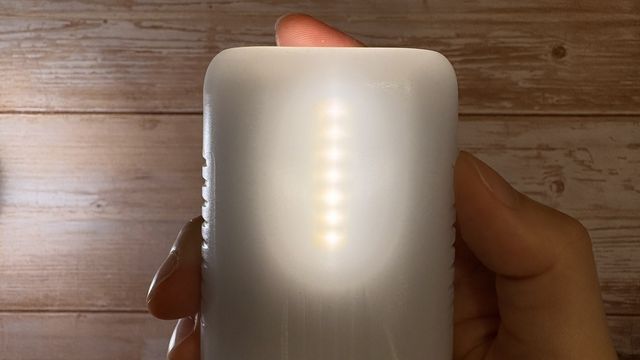
- LEDs: 7 front, 6 top, 7 backnothing on the left or right sides
The diffuser doesn’t do a great job. You can pick out the individual LEDs even on Low, and it gets glaring quickly on the brighter modes.
- Diffuser: High-grade plastic
- Base: Aluminum alloy
- Buttons and port: Rubberized
- Warranty: 2 years

As a lantern you can hang it off the D-ring, stand it upright, or turn it upside down, depending on where you want the light to go. You can also use it while it’s charging.
Portability
- Weight: 9.56oz
- Packed size: 4.4 x 2.4 x 1.3in

Pros, Cons & Recommendations
Now, what are the pros and cons, and would I recommend the Nitecore LR70?
Loads of light modes
You get 12 modes in total:
- White lantern: Low, Mid, High
- Red lantern: Low, High, Beacon, SOS
- Flashlight: Low, Mid, High, Higher, Turbo
It’s also the only one of the 7 lantern flashlights I tested with a red mode, which is exactly what I want in the middle of the night when I don’t want my eyes to readjust.
A huge range of brightness
The lantern goes from 6 lumens to 1,090, and the flashlight from 0.2 to more than 5,000. Nothing else I tested comes close:
| Lantern flashlight | Lantern (lumens) | Flashlight (lumens) | Beam distance |
|---|---|---|---|
| Nitecore LR70 | 6 – 1,090 | 0.2 – 5,099 | 90.0ft |
| Goal Zero Torch 500 | 291 – 1,663 | 31 – 320 | 52.1ft |
| UCO Leschi | 33 – 125 | 49 – 517 | 48.2ft |
| UCO Pika | 5 – 171 | 3 – 148 | 37.5ft |
| Goal Zero Micro Charge | 0 – 265 | 0 – 60 | 25.4ft |
| Goal Zero Micro Flash | 0 – 209 | 0 – 99 | 24.5ft |
| Nitecore LA10 | 31 – 285 | 3 – 28 | 8.6ft |
Nitecore quotes 400 lumens for the lantern on High and 3,000 for the flashlight on Turbo. I measured 1,090 and 5,099, so I got a lot more than I expected.
Great battery capacity
At 10,000 mAh this holds the biggest battery of any lantern flashlight I’ve tested, and the run times show it:
| Lantern flashlight | Battery | Longest lantern run-time | Longest flashlight run-time |
|---|---|---|---|
| Nitecore LR70 | 10,000 mAh | 367 hrs | 780 hrs |
| Goal Zero Torch 500 | 5,200 mAh | 20 hrs | 28 hrs |
| Goal Zero Micro Charge | 2,600 mAh | 274 hrs | 239 hrs |
| Goal Zero Micro Flash | 2,600 mAh | 353 hrs | 308 hrs |
| UCO Pika | 1,800 mAh | 61 hrs | 61 hrs |
| Nitecore LA10 | 1x AA | 16 hrs | 16 hrs |
| UCO Leschi | 1x AA | 11 hrs | 11 hrs |
On the Mid white lantern I got 63 hours, and that was bright enough to light a 5-person tent. At 9 hours a night, that’s a week of camping without a single recharge.
Nitecore quotes 200 hours for the white lantern on Low, and I got 292.
Loads of other features
Away from the light modes, you also get:
- Mobile charging
- Fast charging, in and out
- A low current mode for small devices
- Battery indicator lights
- Flashlight memory
- A magnetic D-ring
- Rain and water-jet proofing
- A 1-meter drop rating
It charges a phone quickly
The 3.0A max current is the highest of the seven, and it showed in how long a full phone charge took:
| Lantern flashlight | Max current | iPhone 12 charge | Time taken |
|---|---|---|---|
| Nitecore LR70 | 3.0A | 75% | 1.00 hrs |
| Goal Zero Torch 500 | 2.1A | 77% | 1.58 hrs |
| Goal Zero Micro Charge | 1.0A | 68% | 1.58 hrs |
| UCO Pika | Not stated | 39% | 1.67 hrs |
That worked out about one and a half times faster than the other lantern flashlights I’ve charged from.
The submersion test killed it
It’s rated IP67, which should mean 30 minutes at 1 meter submerged. Mine was dead the next day with water pouring out of the port, so I’ve put its tested rating at IP66. It takes heavy rain and water jets without any trouble, so just don’t go submerging it and you should be fine.
Heavy
At 9.56oz this isn’t a light you’d clip onto a pack and forget about. Only the Goal Zero Torch 500 is heavier of the seven I tested.
Expensive
Of all the lantern flashlight combos I’ve bought, this is the most expensive one so far.
Overall recommendation
If you want a lantern and a flashlight in one and you don’t mind the weight or the price, the Nitecore LR70 is easily one of the best I’ve tested. It outscored the other 6 by a clear margin, and I thought the price tag was justifiable for everything you get. However, if there’s any chance of it ending up underwater, don’t get this one.
Bonus: Must Read!
To see how the LR70 compares to the other lantern flashlights I tested, check out my Best Lantern Flashlights article.
I measured every number on this page myself.


